Awards for the 2027-2028 program year are contingent on funding of the Fogarty LAUNCH fellowship program and the NPGH LEADERs consortium.
Applications are due September 15, 2026 by 5pm Pacific Daylight Time
To learn more about the program, please join us at the NPGH LEADERs Program & Application Webinar:
June 10, 2026, from 7-8am Pacific Time
On this page:
Eligibility
Application Process
Completing an Application (including NEW Biosketch requirements)
Current approved international sites
Research Priorities
Eligibility:1
To apply for the program you must meet the following requirements:
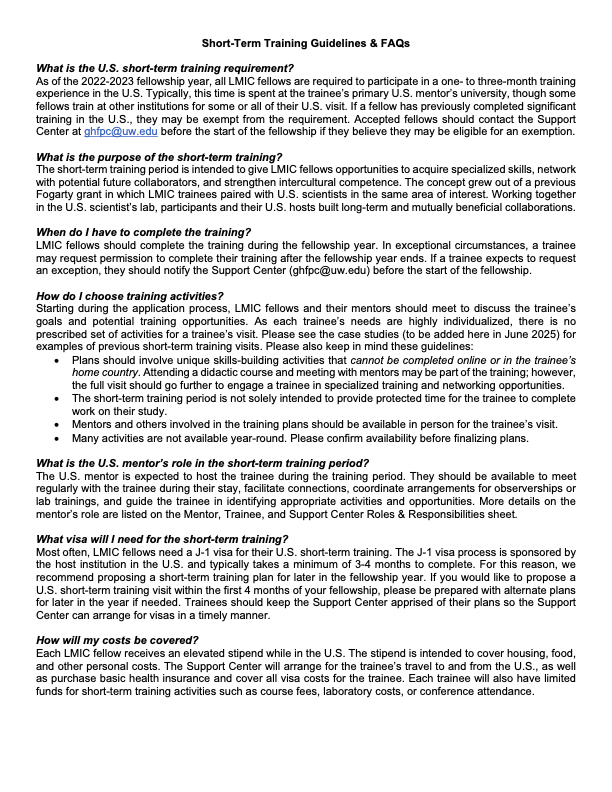
Short-Term Training Guidelines & FAQs
- Have a mentor at a U.S. institution within our consortium (Universities of Michigan, Minnesota, Washington, Indiana University, and University of Hawai’i) who has reviewed and endorsed your NPGH LEADERs application.
- Have a mentor at one of our approved international partner sites (listed at the bottom of this page) who has reviewed and endorsed your NPGH LEADERs application.
- Must propose a research project to be conducted at one of our approved international partner sites.
- Available to dedicate 40 hours per week to research for 12 months at the approved international fellowship site. Outside clinical duties are not allowed during this period.
- Available to begin the fellowship in July 2027.
- Available to spend the 12 months at the fellowship site with limited travel away from the site.
- LMIC trainees must be available to spend 1-3 months of their fellowship at their primary U.S. mentor’s consortium university to participate in short-term training. Please select the table to the right to learn more about U.S. short-term training requirements.
- Applicants can only apply to one Fogarty LAUNCH consortium at a time. For a list of other consortia, please visit: https://www.fic.nih.gov/Programs/Pages/scholars-fellows-global-health.aspx
- Must be a citizen or permanent resident of: the United States, Cameroon, Ghana, India, Kenya, Nepal, Peru, Thailand, Uganda.
- We accept applications from individuals affiliated with any U.S. institution. However, we can only accept applications from LMIC individuals affiliated with one of our approved international partner sites.
- Please note:
- We are unable to consider applications from postdoctoral applicants who are on tenure track.
- Terminal Degree: In recognition of the multidisciplinary demands of global health and that some professions do not normally award doctoral degrees, candidates may be eligible if they have completed the normal terminal degree in their field and can be considered a “post-professional degree” candidate.
U.S. Citizens/Permanent Residents
You are eligible to apply as a postdoctoral trainee if you…
- have completed a doctoral/terminal degree or equivalent in the last 6 years (PhD, MD, DDS, DVM, DrPH, PharmD, etc.).
- completed a doctoral/terminal degree AND are currently in or have recently completed a post-doctoral fellowship (T32 fellowship, medical residency, etc.) or advanced degree (MPH, MSc, etc.).
- will have received a doctoral/terminal degree or equivalent by July 2027.
You are eligible to apply as a predoctoral trainee if you…
- are currently enrolled in a doctoral/terminal degree program and have completed at least one year of studies.
LMIC Citizens/Permanent Residents
You are eligible to apply as a postdoctoral trainee if you…
- have completed a doctoral/terminal degree or equivalent in the last 6 years (PhD, MD, DDS, DVM, DrPH, PharmD, etc.).
- completed a doctoral/terminal degree AND are currently in or have recently completed a post-doctoral fellowship or an advanced degree (MPH, MSc, etc.).
- will have received a doctoral/terminal degree or equivalent by July 2027.
AND
- are a Citizen/Permanent Resident of one of our nine collaborating countries
- are affiliated with an approved partner institution (see list below)
Application Process:2
-
-
- Choose a research site. Review our approved site list (below) and country pages for more information.
- Choose a research area. Review our research priorities listed at the bottom of this page or propose your own area of research based on your interests/training.
- Choose your mentors. Our mentor database is one tool to help you identify potential mentors, though it is not required that your mentors be listed in the database. You can also propose mentors you have already worked with. You must have at least one U.S. mentor at a U.S. institution within our consortium, and one research site mentor at one of our approved international partner sites. If you are unable to find one of the required mentors using your existing professional networks or the mentor database, please contact program staff at ghfpc@uw.edu at least 4-6 weeks before the application due date. In your email, please share your CV, a brief synopsis of your research proposal, and the name(s) of any mentor(s) who have already committed to working with you. Our team will do its best to connect you with a potential mentor for further discussion.
- Write your application!
- You can build upon previous trainee projects or build your own project with the assistance of mentors. To learn about previous trainee projects, please review the trainee section of our website. Here is a helpful resource on how to write a global health research proposal: https://nuwrite.northwestern.edu/communities/global-health/writing-a-global-health-proposal/
- Your application must be reviewed by your proposed U.S. and research site mentors.
- You will need to submit a tentative budget for your study. Please note that funding for research studies is limited to $7,500 for U.S. pre-docs and $10,000 for U.S. and LMIC post-docs.
- Have 2 letters of recommendation uploaded to your application or emailed to ghfpc@uw.edu by September 15th. A 3rd letter of recommendation is optional.
- One letter should be from your primary research site mentor from one of our approved international research sites, and the other letter should be from your primary U.S. mentor from a university within our consortium (Universities of Michigan, Minnesota, Washington, Indiana University, and University of Hawai’i).
- Note for LMIC Fellow Applicants: Letter from U.S. mentor should explicitly mention approval of the applicant’s proposed U.S. short-term training plans.
-
We will review all applications between September-November, conduct interviews in late September-mid October 2026 and update all on the status of applications by February 2027. Fellowships begin July 1.
If you would like to discuss your ideas and background with someone prior to applying, please email program staff at ghfpc@uw.edu for assistance!
Completing an Application 3
Applications can only be submitted online. We have PDFs available to help you see what information will be requested: Online Application Form and Application Essays
A complete application includes the online application form and the submission of letters of recommendation (2 are required and a 3rd letter is optional).
The online application form will require you to submit: unofficial transcripts (predoctoral applicants only), a research proposal, a tentative budget for your study, personal statements, a mentoring plan, a certified NIH Biosketch Common Form (one from you and one from each of your primary mentors), and personal background information. Please note that NIH now requires that all biosketches be prepared and certified in the SciENcv platform. As this is a new system for most people, we strongly recommend starting this process early. These two sites offer guidance:
https://guides.lib.uw.edu/hsl/sciencv
For the research proposal, you are welcome to design your own research study through the guidance of your mentors or to integrate into a study currently being conducted. Here is a helpful resource on how to write a global health research proposal: https://nuwrite.northwestern.edu/communities/global-health/writing-a-global-health-proposal/
Letters of recommendation should be uploaded to your application or emailed to ghfpc@uw.edu by September 15th. Note for LMIC Fellow Applicants: Letter from U.S. mentor should explicitly mention approval of the applicant’s proposed U.S. short-term training plans.
Current approved international sites 4
Your research would need to be conducted at one of these fellowship sites:
Research Priorities:5
We accept applications for research from a variety of disciplines, but have special interest in projects related to the topics listed below. Please closely consider the NIH research priorities linked to each topic when developing your proposal:
-
-
- HIV/AIDS
- Neurology/Nervous System Disorders
- Cardiovascular, Lung & Blood Disease Disorders
- Cancer
- Diabetes, Digestive and Kidney Diseases
- Women’s Health
- Child Health and Human Development
- Mental Health
- Environmental Health
- Behavioral and Social Sciences Research
- Data Science
- Disease Prevention
- Biomedical Imaging and Bioengineering
- Dental, oral and craniofacial health and disease
- Deafness and other communication disorders
- Drug use and addiction
- Eye conditions and disorders
- Nursing research
- Aging research, Alzheimer’s Disease and Related Dementias
-
Are you a U.S. predoctoral student looking for information about the Fulbright-Fogarty Fellowship?
See our Fulbright-Fogarty Fellowship page for details.


